
THE FRAMEWORK
The RAAIG Framework
The institutional architecture for governing agentic AI on your organisation's own terms.
When an autonomous AI agent makes a decision affecting citizens, residents, businesses, sectors, or visitors, who in your organisation can answer for it, on what basis, with what recourse? RAAIG is the framework that lets your leadership answer that question with confidence, across every agentic deployment.
THE ORIGIN
Built for the Era When AI Acts Before it is Reviewed.
Predictive AI governance frameworks were designed for a world where a human reviews an AI recommendation before action follows. Agentic AI operates differently: a task is issued, a chain of reasoning unfolds, actions are taken, consequences land. The governance architecture must be present at the point of deployment, not inserted after the fact.
Frameworks adapted from Western governance traditions cannot answer the questions specific to this region's governance heritage and strategic ambition. RAAIG was built from inside the regional challenge outward, grounded in doctoral research on UAE government AI governance, and designed to operate within the institution's existing management system.
THE ARCHITECTURE
Five Pillars. One Foundation. Three Horizons.
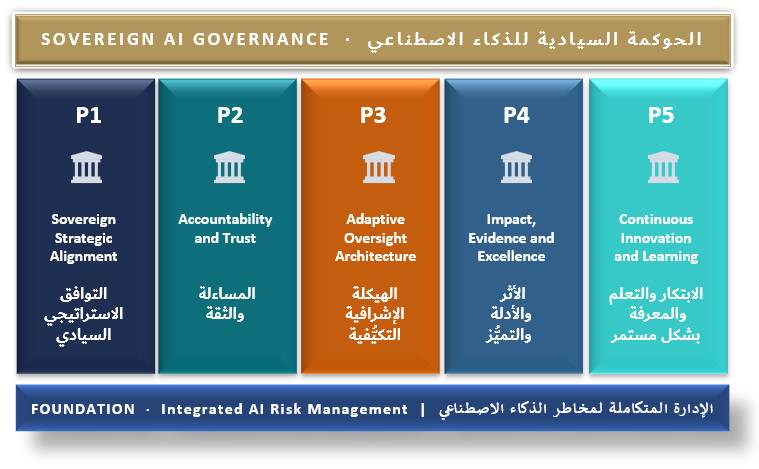
P1 — Strategic Alignment
Every agentic AI deployment maps to a named strategy, with documented rationale and traceability.
P2 — Accountability and Trust
Role-anchored accountability for every consequential decision, with the current occupant recorded in the deployment documentation.
P3 — Adaptive Oversight Architecture
Five oversight modes matched to risk: HITL, HOTL, SITL, Independent Assurance, Kill-Switch.
P4 — Impact, Evidence and Excellence
Evidence produced as a by-product of operation, aligned with Excellence Award dimensions.
P5 — Continuous Innovation, Learning and Knowledge
Governance practice that evolves with the technology and the institution.
THE OPERATIONAL CONCEPTS
Two Concepts at the Heart of RAAIG.
The Accountability Handshake
A three-party compact between the Organisation, the Humans Affected, and the Governance Framework. The mature expression of Pillar 2. First presented at DIFC FinTech Hive, April 2026.
Governance Debt
The diagnostic concept measuring the distance between current state and the institutional capacity required to advance the journey toward Sovereign AI Governance. The instrument that locates an organisation on the journey, and the methodology that closes the gap.
MATURITY MODEL
A Journey, Not a Destination.
Sovereign AI Governance is built deployment by deployment, role by role, evidence by evidence. The maturity model locates your organisation on the journey. The practice evolves with the technology and your institution's ambition.
Governance awareness established; initial policies in place.
Framework adoption under way; accountability roles defined.
Evidence-producing governance; Pillar 2 fully implemented.
Systematic closure; ISO 42001 aligned; leadership sign-off cycle established.
Governance as institutional competitive advantage; contributing to regional standards.
DISTINCTION
Five Commitments That Position RAAIG.
Sovereignty-anchored
Built for the region's governance traditions and strategic posture. Not adapted from elsewhere.
Organisation-focused
Assesses institutional readiness at the level at which agentic governance actually operates. Entity-level maturity, not function-level technical compliance.
Practitioner-built
Grounded in doctoral research on UAE government AI governance, delivered by the practitioner who developed the framework.
Original concepts
The Accountability Handshake and Governance Debt are original Knowledge Way contributions, offered for citation, adoption, and refinement.
Closure-oriented
Provides a structured methodology for moving from awareness of governance gaps to evidenced closure. Not a diagnosis tool. An operating model.
STANDARDS ALIGNMENT
Operates Within the ISO 42001 Envelope.
RAAIG operates within the ISO/IEC 42001 management system envelope and contributes the agentic-specific governance content that ISO 42001 calls for but does not prescribe. Dr. Moayyad Etoom holds the ISO 42001 Lead Implementer credential, one of a small number of practitioners in the region.
FROM FRAMEWORK TO IMPLEMENTATION
How Organisations Apply RAAIG.
Executive Leadership Workshop
A two to three hour facilitated working session for boards and executive teams. Map your Governance Debt starting point and identify the priority closure areas.
Structured Assessment and Closure Roadmap
A multi-week professional engagement delivering the Governance Debt Profile, Framework Readiness Profile, and a prioritised closure roadmap your leadership and board can sign off on.
Ready to Discuss How RAAIG Applies to Your Organisation?
A focused conversation with Dr. Moayyad Etoom. No obligation.