AGENTIC AI GOVERNANCE
Governing AI when AI Acts on Your Behalf.
Agentic AI systems decide and execute. They do not just inform. Governance built for predictive AI is no longer enough. Knowledge Way's RAAIG Framework is built for the era when AI acts before it is reviewed.
THE SHIFT
Agentic AI is Not the Next Wave of AI. It is a Different Discipline.
The AI governance frameworks most organisations adopted over the past five years were designed for predictive and generative systems that inform human decisions. Agentic systems are different. They decide. They act. They execute across systems and organisational boundaries before any human reviews the outcome.
Predictive AI
Forecasts an outcome. A human decides what to do with the forecast. Governance focused on model fairness and accuracy.
Generative AI
Produces content for human use and review. Governance focused on output quality, IP, and disclosure.
Agentic AI
Decides and acts on the organisation's behalf, often across multiple systems. Governance must answer who is accountable, on what authority, and with what evidence.
THE NEED
Without Agentic AI Governance, The Institution is Not the Author of its Decisions.
When an autonomous agent acts on an organisation's behalf, it acts on the basis of its design: its training, its optimisation logic, its operational rules. Without governance architecture in place, decisions are made and outcomes produced, but no named human has claimed authority over what the AI decides.
Executing transactions autonomously
Defined for human-in-the-loop oversight only
No accountable owner when something goes wrong
Acting across multiple systems and boundaries
Set at the level of individual deployments
Aggregate behaviour invisible to leadership
Making decisions that affect citizens or customers
Lacking a recourse pathway for affected parties
Trust gap that will not survive first incident
Predictive AI governance is necessary. For agentic AI, it is not enough.
KNOWLEDGE WAY'S POINT OF VIEW
Sovereignty in the Agentic Era is Built at the Institutional Level.
Data sovereignty and infrastructure sovereignty are established dimensions of national AI policy across the UAE and the region. They answer where the data resides and what infrastructure runs the model. They do not, on their own, answer the question of whether the institution commands what the AI does.
Data Sovereignty
Where data resides and under whose law.
Infrastructure Sovereignty
Compute and infrastructure under institutional control.
Governance Sovereignty
The institutional capacity to govern agentic AI on the organisation's own terms, in alignment with national policy.
Knowledge Way calls this fourth dimension Governance Sovereignty. It is the discipline of the era we are entering.
THE METHODOLOGY
The RAAIG Framework. Built for the Agentic AI Era.
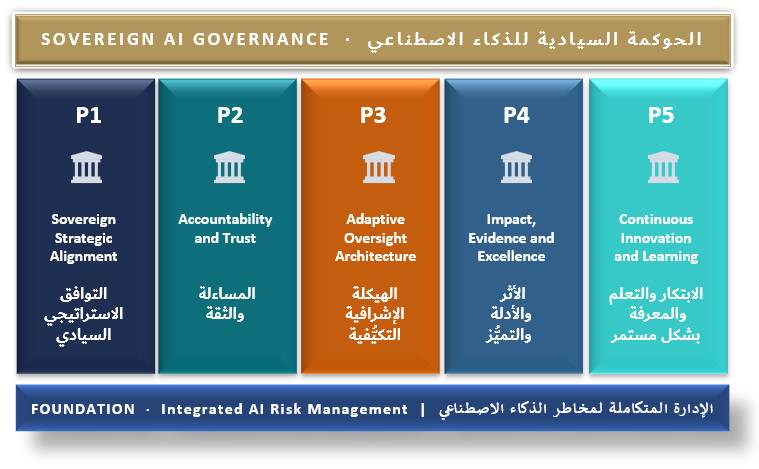
Knowledge Way has developed RAAIG (Responsible Agentic AI Governance) as the institutional architecture by which an organisation builds governance sovereignty. The framework rests on five integrated pillars and one continuous foundation, designed to operate within the existing AI governance architecture an organisation already has.
Integrates, not replaces
Designed to integrate with the AI governance architecture an organisation has today, at whatever stage of maturity.
Sovereignty-anchored
Built specifically for the region's governance traditions and strategic posture, not adapted from a Western frame.
Closure-oriented
Provides a structured methodology for moving from awareness of governance gaps to evidenced closure.
THE DIAGNOSTIC
Most Organisations Carry Governance Debt. It Closes Through a Structured Pathway.
Governance Debt accumulates silently when AI systems are deployed without named accountability, adaptive oversight, alignment evidence, integrated risk management, or trust architecture. It compounds with every additional inadequately governed deployment. It is the diagnostic by which Knowledge Way calibrates engagement to actual current state.
IDENTIFY
Map current governance against the framework. Understand where the debt sits and at what materiality.
PRIORITISE
Sequence by risk. Not all debt carries equal consequence.
CLOSE
Implement targeted governance interventions against the prioritised gaps. The assessment drives the work.
EVIDENCE
Capture what was done, how it was validated, and what outcomes it produced.
Begin Your Agentic AI Governance Journey. Start With a Free Consultation.
A focused conversation with Dr. Moayyad Etoom on where your organisation stands on agentic AI governance, what your Governance Debt likely looks like, and what the right next move is.
Book a Free ConsultationConfidential. Practitioner-delivered. No obligation.
WHY KNOWLEDGE WAY
Practitioner Authority on Agentic AI Governance.
Original Framework
RAAIG is an original contribution by Knowledge Way to agentic AI governance, not a consulting product adapted from elsewhere. The Accountability Handshake and Governance Debt concepts were first presented at DIFC FinTech Hive in April 2026.
ISO 42001 Grounded
RAAIG operates within the ISO/IEC 42001 management system envelope. Dr. Moayyad Etoom holds the ISO 42001 Lead Implementer certification, one of a small number of practitioners in the region.
UAE-Anchored
Built from inside the regional governance tradition outward, with doctoral research focused specifically on AI governance in the UAE government sector.